
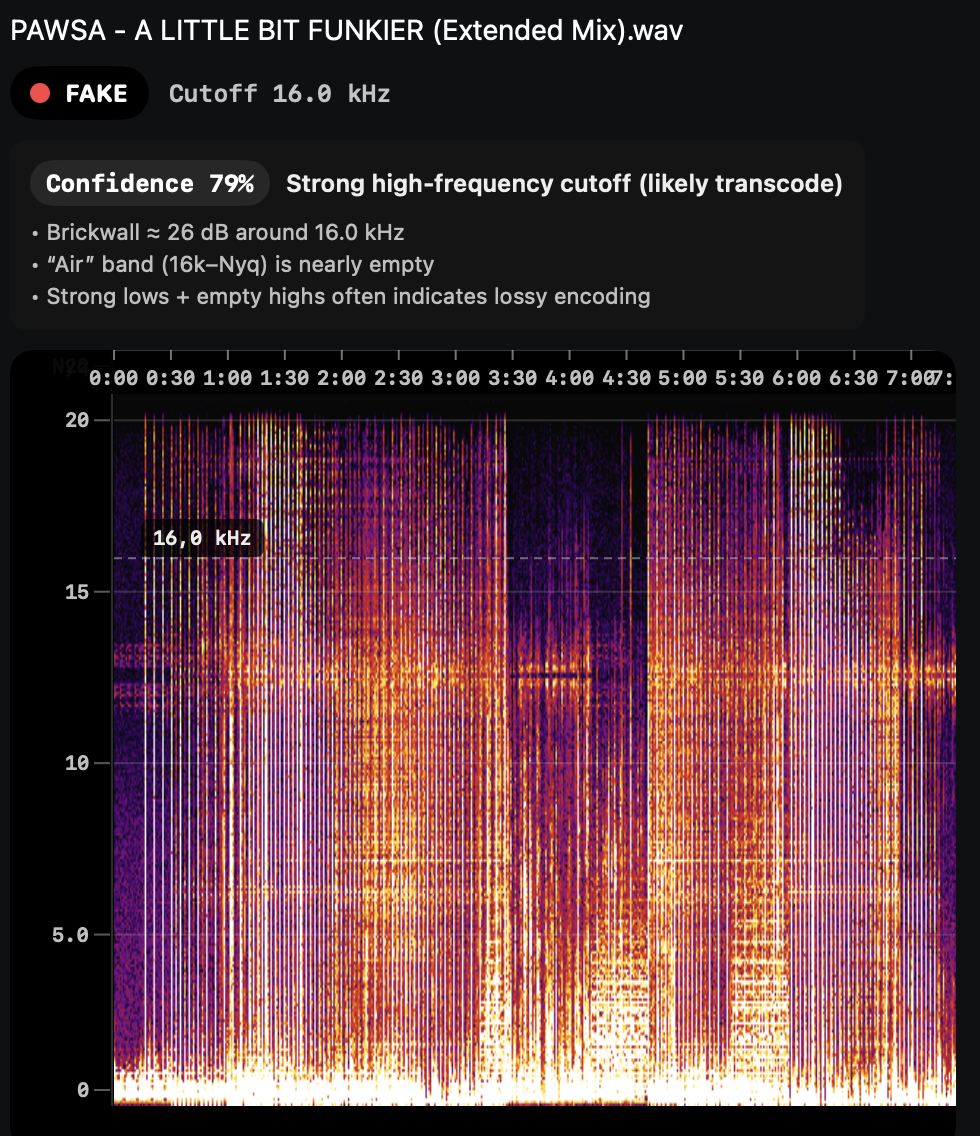
Typical transcode pattern: hard cutoff around 16 kHz and weak upper band.
Serato workflow
Verify your crates before the gig. Spectro flags fake lossless files so every track Serato loads is actually what it claims to be.
Serato reads file metadata: name, BPM, key, duration, and file type as declared in the header. If a file says WAV, Serato treats it as WAV. It has no mechanism for spectral analysis and won't flag a file that was transcoded from MP3 before being saved as WAV.
Spectro reads the actual frequency content of the file — the same information a trained ear would use to evaluate audio quality on a spectrogram. The detection method is backed by peer-reviewed research (D'Alessandro & Shi, ACM MM&Sec 2009) with 99% accuracy across 2,512 songs in a controlled test.
Spectro highlights obvious cutoff behavior and high-frequency continuity, so you can spot transcodes quickly.
Typical transcode pattern: hard cutoff around 16 kHz and weak upper band.
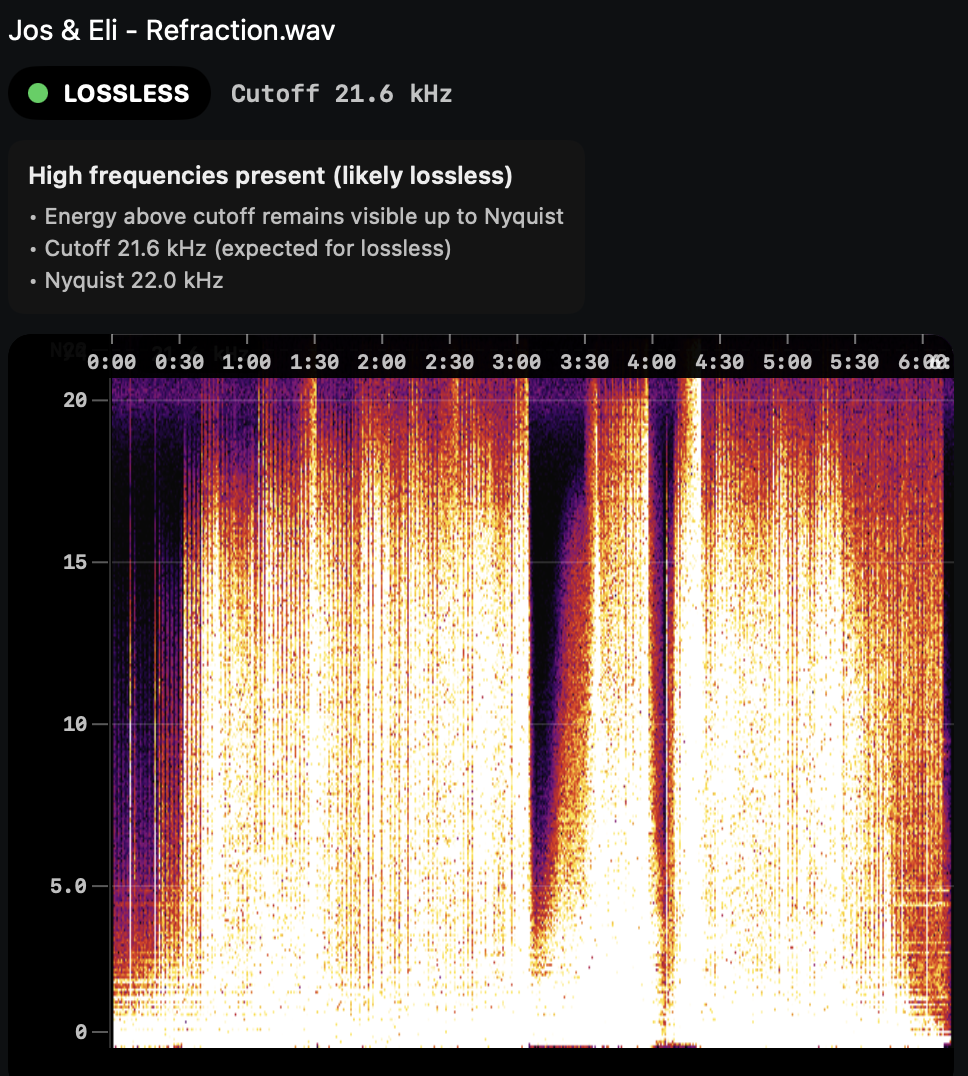
Lossless profile: high-frequency energy remains visible near Nyquist.
No. Spectro is an independent macOS app that complements your Serato workflow. It is not affiliated with, endorsed by, or connected to Serato in any way.
No. Spectro analyzes audio files on disk and can write macOS Finder tags. Your Serato library database remains completely separate and untouched.
Yes. Spectro works on audio files directly — it's source-agnostic and acts as a quality gate regardless of which DJ software you use.
Spectro's spectral analysis is based on peer-reviewed research (ACM MM&Sec 2009) that achieved 99% accuracy on transcoding detection across 2,512 songs. The only known ambiguous case is 256 kbps CBR vs. high-quality VBR MP3, which Spectro flags explicitly in the diagnosis panel.
Run a free batch on your crate files and see how many tracks need replacement before your next gig.
Serato is a trademark of its respective owner. Spectro is independent and not endorsed by or affiliated with Serato.