
Spectro Team · April 30, 2026 · 4 min read
Is DJcity Audio Actually Lossless?
DJcity is one of the most widely used record pools for club DJs. But are its WAV downloads genuinely lossless? Here's what you need to know and how to verify.
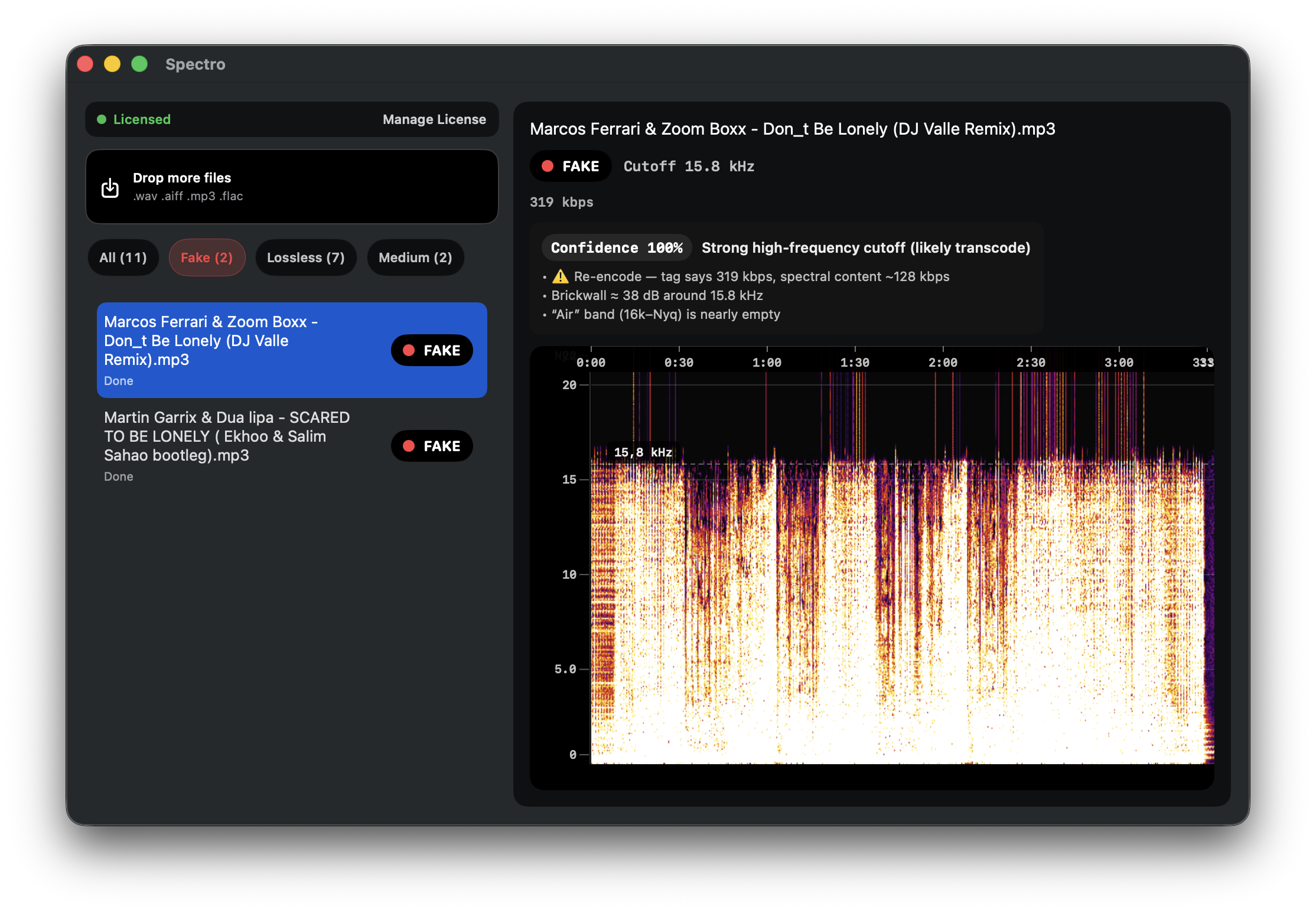
Quick Answer: DJcity provides WAV and MP3 downloads through a label-to-pool distribution chain. Quality depends on what labels submit — not all WAV files on DJcity are verified lossless. Record pools in general receive high volumes of automated uploads with inconsistent quality control. The only reliable verification is spectral analysis of the file itself.
DJcity is one of the most widely subscribed record pools among working club DJs, particularly in hip-hop, R&B, open format, and mainstream dance. Its catalog is broad and updated frequently. For DJs building active libraries from DJcity downloads, the question of actual audio quality — not just labeled quality — matters more than most assume.
How does DJcity source and distribute audio?
DJcity operates as a record pool: labels and distributors submit tracks, and subscribers download them. The platform receives files from a large number of labels ranging from major releases to independent imprints. Like all record pools, DJcity depends on submitters to provide high-quality masters.
The platform offers WAV downloads at higher subscription tiers, marketed as higher quality than the MP3 tier. What the WAV label indicates is the container format — not a guarantee that the audio inside was never lossy.
What are the quality risks specific to record pools?
Record pools face a structural quality challenge that stores like Beatport do not face to the same degree. The volume of uploads is high, the sources are numerous, and many labels use automated distribution pipelines that can introduce transcoding silently.
Specific risks with DJcity and record pools generally:
Automated format conversion. Distributors sometimes convert everything to a standard format before delivery. A file that entered the pipeline as 320 kbps MP3 can arrive at the record pool as WAV with no flag raised.
Radio edits and remixes from unknown sources. Edits and remixes often circulate in lower quality before being officially mastered. A WAV of a radio edit may have been assembled from MP3 sources.
Speed of delivery. Record pools are valued partly for fast delivery of new releases. Fast turnaround sometimes means less quality oversight.
Legacy catalog. Older titles in a record pool catalog may have been uploaded years ago from lower-quality sources, before quality standards for digital distribution were more widely enforced.
How does DJcity's quality compare to direct store purchases?
Direct store purchases from Beatport or Traxsource go through a more curated label-to-store pipeline where the label relationship is more direct and quality expectations are more formalized. Record pools are downstream aggregators — they receive what labels choose to send, and what labels send to pools is not always the same master they send to stores.
This is not a criticism of DJcity specifically — it applies to all record pools. The structural difference means that pool downloads carry slightly higher uncertainty than direct store purchases for the same track, particularly for older catalog and edits.
How do you verify DJcity downloads?
The verification process is the same regardless of source:
Batch scan: Download your new tracks to a staging folder. Drag the folder into Spectro before importing into your DJ software. Each file receives a LOSSLESS, FAKE, or MEDIUM verdict. Flag anything marked FAKE for replacement.
Spot check: For a quick check on a specific file, open it in Spek and look for a hard frequency cutoff above 15 kHz. Genuine lossless files show energy gradually rolling off toward 22 kHz. Fake files show a flat wall at the original encoder's cutoff point.
Building this check into your weekly download workflow takes under five minutes and removes uncertainty from your library permanently.
Should you replace FAKE files from DJcity?
If a file is flagged as FAKE and the track is available as a genuine lossless download from Beatport or Traxsource, replace it. If no lossless version is available and you need the track, a high-quality MP3 downloaded directly from a store is a more honest representation than a fake WAV from any source.
For more on how to interpret scan results, see How to Detect Fake Lossless Audio Files on Mac. For comparison with store quality, see Is Your Beatport Download Actually Lossless?.
Related posts
Try Spectro free
100 files free. No account needed. Buy for $39 when you're ready.
Download Spectro — $39